
Buying guide · Tianhua Transformer engineering team
Fix seven things in order: load in kVA, voltage ratio, transformer type (oil-immersed, dry-type, pad-mounted, pole-mounted or compact substation), standard (IEC or IEEE), cooling, losses and site conditions. Estimate peak simultaneous demand in kVA, allow for planned growth, then shortlist an available rating that meets the project conditions.
This guide from our design engineers walks through each decision with formulas, tables and the information we need to quote.
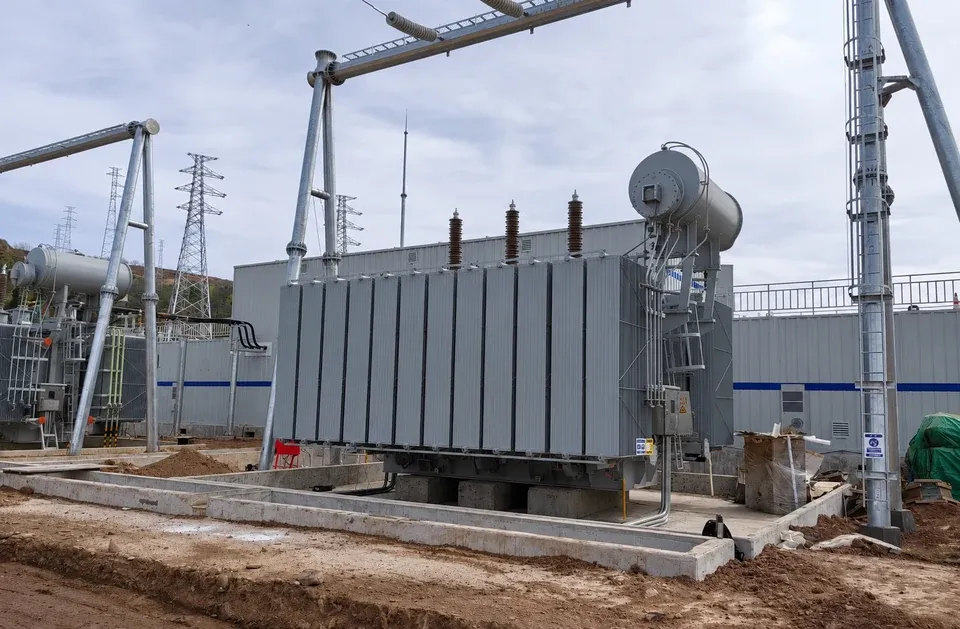
| 1. Capacity | Peak demand in kVA, with an allowance based on the project’s load growth plan |
|---|---|
| 2. Voltage | Primary = supply network; secondary = equipment voltage; add taps |
| 3. Type | Oil-immersed outdoors, dry-type indoors, pad-mounted for underground networks, pole-mounted for overhead lines |
| 4. Standard | IEC 60076 (mostly 50 Hz) or IEEE / ANSI C57.12 (mostly 60 Hz) |
| 5. Cooling | ONAN for distribution; ONAF / OFAF for larger units |
| 6. Losses | Compare total cost of ownership, not price alone |
| 7. Site | Altitude, ambient temperature, corrosion, space and fire rules |
Start with the maximum load expected to run at the same time. Use measured peak demand or a load schedule that shows which loads operate together. If the peak load is in kW, use the power factor at that operating point to estimate kVA.
Worked example: A peak of 640 kW at a power factor of 0.80 is 800 kVA. If the project allows 20% for growth, the target is 800 × 1.20 = 960 kVA. A 1,000 kVA unit is a candidate if it can carry the required load under the specified conditions.
Choose the allowance from the expansion plan. Before finalising the rating, confirm any motor-starting, harmonic or standby duty requirements and check the available capacity at the site’s temperature and altitude. These are examples of commonly offered ratings:
| Standard | Common three-phase ratings (kVA) |
|---|---|
| IEC | 100, 160, 200, 250, 315, 400, 500, 630, 800, 1,000, 1,250, 1,600, 2,000, 2,500 |
| IEEE / ANSI | 45, 75, 112.5, 150, 225, 300, 500, 750, 1,000, 1,500, 2,000, 2,500, 3,750, 5,000 |
The table gives reference full-load currents at nominal secondary voltage for balanced three-phase units. Confirm cable and switchgear sizing against the project’s installation and protection requirements.
| LV voltage | Full-load current |
|---|---|
| 400 V | 250 kVA ≈ 361 A, 630 kVA ≈ 909 A, 1000 kVA ≈ 1,443 A, 1600 kVA ≈ 2,309 A, 2500 kVA ≈ 3,608 A |
| 480 V | 250 kVA ≈ 301 A, 630 kVA ≈ 758 A, 1000 kVA ≈ 1,203 A, 1600 kVA ≈ 1,925 A, 2500 kVA ≈ 3,007 A |
| 208 V | 250 kVA ≈ 694 A, 630 kVA ≈ 1,749 A, 1000 kVA ≈ 2,776 A |
The primary voltage is your supply network, for example 6.6, 10, 11, 13.8, 20, 33 or 34.5 kV. The secondary is the voltage your equipment uses: 400 V or 415 V in IEC regions, 208Y/120 V or 480Y/277 V in North America, or 690 V and above for industry and inverters.
Add a tap changer so the output can be adjusted: an off-circuit tap changer (typically ±2 × 2.5%) where the grid voltage is stable, or an on-load tap changer (OLTC) where it varies under load. Also give the vector group, for example Dyn11 for distribution transformers.
| Type | Typical range | Best for | Guide |
|---|---|---|---|
| Oil-immersed distribution | 30–3,150 kVA, 6–35 kV | Outdoor substations, utilities, industry; lowest cost per kVA, good overload capacity | Read |
| Dry-type (cast resin / VPI) | 30–2,500 kVA, 6–24 kV | Indoors and fire-sensitive sites: buildings, hospitals, data centers, metro | Read |
| Pad-mounted | 45–5,000 kVA three-phase | Underground cable networks, housing, commercial, solar; locked cabinet on a concrete pad | Read |
| Pole-mounted | 5–167 kVA single-phase | Overhead rural and residential lines | Products |
| Compact substation | 6–40.5 kV | MV switchgear, transformer and LV board in one enclosure; fast installation | Read |
| Power transformer | 35–220 kV, 0.8–360 MVA | Grid substations, power plants, heavy industry | Read |
| IEC 60076 | IEEE / ANSI C57.12 | |
|---|---|---|
| Where used | Europe, Middle East, Africa, most of Asia | North America and many Latin American and Philippine utilities |
| Frequency | Mostly 50 Hz | Mostly 60 Hz |
| Typical LV | 400 V, 415 V, 433 V | 208Y/120 V, 240 V, 480Y/277 V, 600 V |
| Ratings | kVA steps 100, 160, 250, 400, 630… | kVA steps 45, 75, 112.5, 150, 225, 300, 500… |
The standard changes ratings, insulation levels, test values, bushing layout and nameplate, so state it in the enquiry. Tianhua designs to both, as well as China GB 1094.
| Code | Meaning | Used for |
|---|---|---|
| ONAN | Oil natural, air natural | Standard for distribution transformers |
| ONAF | Oil natural, air forced (fans) | Extra capacity at peak load on larger units |
| OFAF / ODAF | Oil pumped through coolers with fans | Large power transformers |
| AN / AF | Dry-type, natural air or fans | Dry-type transformers; fans give short-term extra capacity |
No-load (core) loss is paid 24 hours a day, whatever the load. Load (copper) loss rises with the square of the load. A cheaper transformer with higher losses often costs more over its life.
Compare offers by total cost of ownership = price + A × no-load loss + B × load loss, where A and B are the capitalised values of 1 kW of loss over the transformer life.
For lightly loaded networks, amorphous alloy (SH15, SCBH15) or S20 / S22 low-loss designs usually give the lowest total cost. Check the efficiency rule in your country, such as EU Ecodesign Tier 2, US DOE 2016 or China GB 20052.
A single-line diagram or load list is enough to start. Our engineers check the sizing for free.
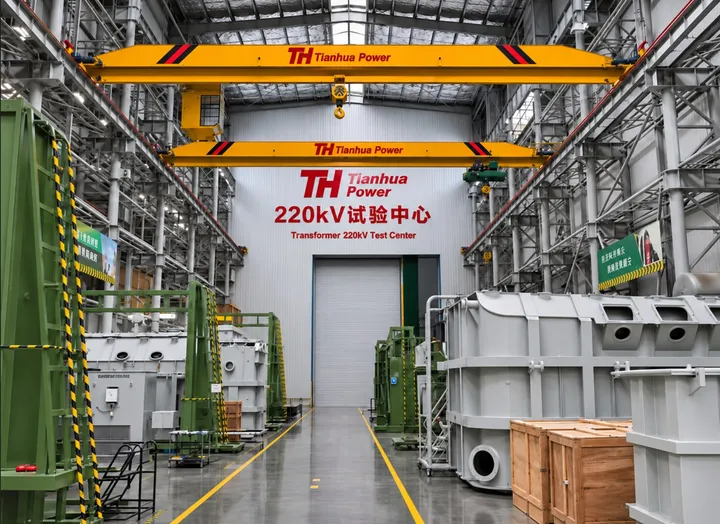
This guide is written by the engineering team of Jiangsu Tianhua Transformer Co., Ltd., a transformer manufacturer founded in 2013 in Xuzhou, Jiangsu, China. Every unit is designed, built and tested in our own 107,000 m² plant: core cutting, winding, drying, resin casting, tanks, radiators, assembly and testing. You deal directly with the factory engineers.
About Tianhua · Factory and testing · Certificates · Projects
Estimate the maximum simultaneous demand in kVA. If you know peak kW and the power factor at that load, divide kW by power factor. Add the capacity needed for planned expansion and verify that an available rating meets the site and operating requirements.
At a power factor of 0.80, a 500 kW peak is 625 kVA. A 20% growth allowance gives 750 kVA. A 25% allowance gives 781.25 kVA. At 25%, consider 800 kVA if offered, or 1,000 kVA if the approved range jumps from 750 to 1,000 kVA. Confirm the applicable ratings and site duty before ordering.
Oil-immersed costs less per kVA and suits outdoor sites. Dry-type has no oil, so it suits indoor and fire-sensitive sites such as hospitals, high-rise buildings and data centers.
IEC 60076 is used in most 50 Hz markets; IEEE / ANSI C57.12 in North America and other 60 Hz markets. They differ in ratings, test levels, voltages, bushing layout and nameplate.
Yes. Send your load list or single-line diagram to sale@thatransformer.com and our engineers recommend the rating and type, with a datasheet and price within 24 hours.
For commercial and light industrial sites, 315 to 1,600 kVA at 400 V is most common. Utilities often use 100 to 630 kVA units on their distribution networks.
Products
Send capacity, voltages, standard, quantity and destination. Our engineers reply with a datasheet and price within 24 hours.
Written by the Tianhua Transformer engineering team, Xuzhou, China. Last updated November 2026.