
Answers from our sales and engineering team at the factory in Xuzhou, China.
Common searches:
148 answers in 15 topics
No answer found for “”.
Send the question to our engineers and we will reply within one working day.
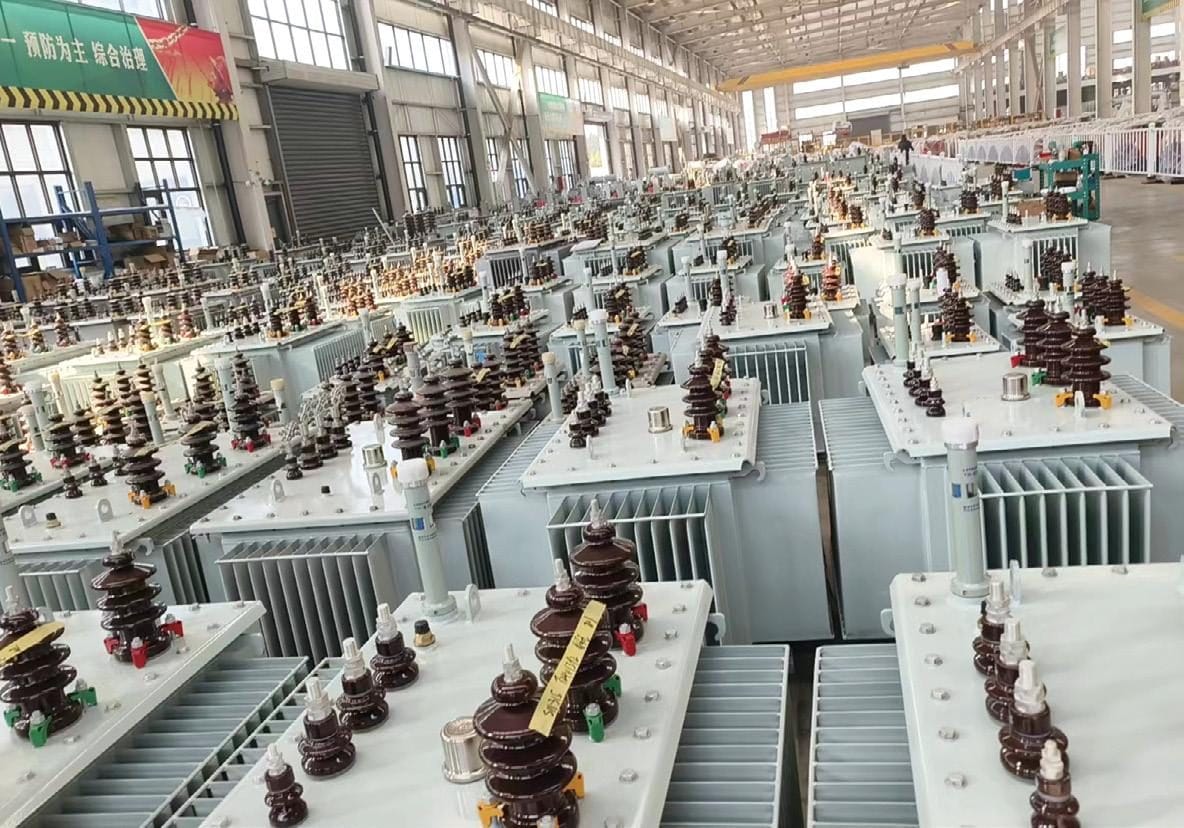
Jiangsu Tianhua Transformer Co., Ltd. (brand THA 天华), a transformer manufacturer in Xuzhou, Jiangsu Province, China. We design, build and test every transformer, substation and switchgear panel on this website in our own plant.
A manufacturer. Every product is designed, built and tested in our own factory in Xuzhou. You deal directly with the factory engineers and sales team, with no trading company in between.
No. 105 Xuhai Road, Economic and Technological Development Zone, Xuzhou, Jiangsu Province, China. Xuzhou is where the Beijing–Shanghai and Longhai railways meet, with direct road and rail links for export shipments.
The site covers 107,000 m² of land with a planned floor area of 80,000 m². Completed factory buildings cover 50,000 m², with a further 23,000 m² under construction. There is also a 4,500 m² office and R&D building.
More than 500 employees, including 7 senior engineers and more than 110 technical staff with master's or doctoral degrees.
Total investment is 250 million yuan and registered capital is 100 million yuan.
Our products are exported to more than 30 countries and regions. Export markets include Indonesia, Kazakhstan, Vietnam, Russia, the Philippines, Saudi Arabia, Southeast Asia and South America.
Our equipment has been supplied to projects including Beijing Daxing International Airport, the 2022 Beijing Winter Olympics, the Jiuquan Satellite Launch Center, the G20 Hangzhou Summit, Sinopec, China General Nuclear Power Group, Geely Holding Group and the People's Bank of China.
Yes. You are welcome to visit the plant in Xuzhou, join a live video tour of the production lines, or send your own inspector. See our factory and testing
Servo slitting and cross-cutting lines for silicon steel, step-lap core stacking, horizontal and vertical winding machines, LV foil winding machines, vacuum resin casting tanks and curing ovens, fiber laser cutting, CNC turret punching and bending, our own panel radiator workshop and a test center.
Yes. High-voltage transformers are designed with Toshiba analysis software and our own calculation and validation procedures, covering the core, coils, active part, leads and tank.
Power transformers from 35 kV to 220 kV, oil-immersed and dry-type distribution transformers, amorphous alloy transformers, pad-mounted and pole-mounted transformers, special transformers (rectifier, furnace, traction, mining, phase-shifting, K-factor), compact and prefabricated substations, MV and LV switchgear, and panel radiators.
From 5 kVA single-phase pole-mounted transformers up to 360 MVA, 220 kV power transformers.
Distribution transformers for 6, 6.3, 10, 10.5, 11, 20, 22, 33 and 35 kV networks; power transformers at 35 kV, 110 kV and 220 kV; compact substations up to 40.5 kV; and 12 kV switchgear. Other voltage ratios are designed to order.
Yes. Oil-immersed: S11, S13, S13·RL, S20, S22, SH15 amorphous and 20–35 kV designs. Dry-type: SC(B)10, 12, 13, SCB14, SCB18, SC(B)H15 amorphous and SG(B)13 VPI. Compare oil-immersed series · compare dry-type series.
Yes. YB European-type prefabricated substations, ZGS American-type combined substations, three-chamber box substations, integrated step-up box transformers for solar and BESS, inverter-booster integrated substations and 20 ft prefabricated cabin substations. Compare substation types
Yes. KYN28A-12 metal-clad withdrawable switchgear, GGD fixed LV switchboards and withdrawable LV switchgear for power plants, petrochemical, metallurgy and high-rise buildings, rated up to 4,000 A at 380–660 V. See switchgear
Yes. We make PC and PG panel radiators to JB/T 5347 in fixed, folding and bottom-blown types. For OEM partners we also discuss cores, windings and continuously transposed conductor (CTC).
Yes: rectifier transformers (6, 12 and 24-pulse), electric arc and submerged arc furnace transformers, railway traction transformers, mining transformers, phase-shifting VFD transformers, double-split solar transformers, split-winding transformers and K-factor transformers. See special transformers
Usually yes. Capacity, voltage ratio, vector group, impedance, losses, cooling, tap changer, dimensions, bushings and accessories are designed to your specification or drawing. Send the data sheet and we confirm feasibility within 24 hours.
Yes. One order can combine transformers, compact substations, MV switchgear and LV switchboards from one factory. That means one supplier, one set of drawings and one shipment. See solutions by industry
A transformer whose core and windings sit in a steel tank filled with insulating oil. The oil insulates and carries heat to the tank fins or radiators. It is the standard choice for outdoor utility, pole, pad and substation installations.
M means fully sealed. The corrugated tank fins expand and contract with the oil, so there is no conservator and the oil is isolated from air. No routine oil treatment is needed.
They are loss levels. S13-M has no-load loss on average 37% lower than S11. S20-M meets energy efficiency grade 2 and S22-M grade 1 of GB 20052-2020, the lowest losses. At 1,000 kVA, no-load loss is 745 W for S20 and 665 W for S22.
830 W, with a load loss of 10,300 W, 1.0% no-load current and 4.5% impedance. Full S13 table
810 W, with load loss 6,200 W, no-load current 1.1% and impedance 4.5%.
S11-M covers 30–2,500 kVA at 6–11 kV / 0.4 kV. S13-M and S13-M·RL cover 30–3,150 kVA at 6–10 kV / 0.4 kV.
Its core is three continuously wound frames arranged in a triangle, with no joints. Against a stacked core, no-load loss is 18–28% lower, no-load current 50–60% lower and noise 5–10 dB lower.
A transformer whose core uses 0.027 mm amorphous alloy strip of iron, silicon and boron instead of silicon steel. It magnetises more easily, so no-load loss is much lower. Our SH15-M oil type has no-load loss about 70% below GB/T 6451.
A 400 kVA SH15 has a no-load loss of 200 W against 570 W for an S11. That saves about 3,200 kWh a year, because no-load loss is drawn 24 hours a day.
Dyn11 and Yyn0 are standard on our 10 kV distribution transformers. Dyn11 reduces harmonics on the network. Other vector groups are designed to order.
An off-circuit tap changer with ±5% or ±2×2.5% taps as standard. On-load tap changers are used on 35 kV and above when the grid voltage varies under load.
S13-M noise is about 20% below JB/T 10088-2004, and S20/S22 about 20% below JB/T 10088-2016. A guaranteed sound level for your rating is stated in the datasheet.
Yes. We design to 11 kV, 33 kV, 0.415 kV and other ratios for export markets, including 20 kV / 22 kV and 33 kV / 35 kV distribution transformers. See 33 kV transformers
Yes, oil-immersed distribution transformers designed for higher short-time overloads, for rural networks and seasonal loads. See high-overload transformers
A transformer with no oil. The windings are cast in epoxy resin (cast resin) or vacuum impregnated (VPI) and cooled by air. It can be installed indoors close to the load because there is no fire or leak risk from oil.
Choose dry-type indoors and where fire safety matters: hospitals, high-rise buildings, data centers, tunnels, airports and shopping centers. Choose oil-immersed outdoors, at higher voltages and capacities, and where first cost matters most.
Cast resin coils are fully encapsulated in epoxy. Our SG(B)13 VPI windings are vacuum impregnated with class H (180°C) insulation. They dissipate heat well and carry 120% load continuously and 140% for 3 hours without fans.
SC(B)12 and SC(B)13 are controlled to 5 pC or less, and SCBH15 to less than 10 pC. This comes from vacuum resin mixing, degassing and vacuum casting of the coils.
Cast resin units are rated with load loss at 120°C (class F) and 145°C (class H) reference temperatures. The SG(B)13 VPI type uses class H (180°C) insulation.
They are loss levels. SC(B)13 no-load loss is over 30% below SC(B)10. SCB14 meets energy efficiency grade 2 and SCB18 grade 1 of GB 20052-2020. At 1,000 kVA, no-load loss is 1,275 W for SCB14 and 1,020 W for SCB18.
Yes. The SC10 35 kV series covers 50–2,500 kVA, HV 35–38.5 kV, with 6% impedance. Insulation: highest voltage 42 kV, 70 kV power-frequency withstand and 170 kV lightning impulse.
Yes, for short periods with forced-air cooling. The SC(B)H15 amorphous dry type runs at 150% load with fans. The temperature controller protects the windings with alarm and trip signals.
Yes. A digital temperature controller monitors each winding, starts and stops the cross-flow fans automatically, and gives alarm and trip signals.
Yes. The coils are flame retardant and self-extinguishing. The resin gives off no toxic gas under high heat, and the SG(B)13 gives almost no smoke in an open flame.
A dry-type transformer can go in an electrical room without an enclosure, or inside a metal enclosure for protection and safety. Tell us the IP rating you need and we confirm the enclosure in the datasheet.
Yes. SCB14 and SCB18 have a moisture-proof design for humid environments. Our catalogue gives an ambient temperature range of −50°C to +50°C for dry-type designs, and SG(B)13 can take full load straight after storage at ±50°C.
The SC(B)H15 combines an amorphous alloy core with cast resin coils. Its no-load loss is about 75% below GB/T 10228. At 1,000 kVA it is 550 W, against 1,275 W for an SC(B)13.
35 kV: 630–31,500 kVA. 110 kV: 6.3–63 MVA. 220 kV: 31.5–360 MVA. 220 kV three-winding autotransformers: 31.5–240 MVA. See power transformers
Yes. The SZ11 35 kV series has an on-load tap changer with ±3×2.5% taps for 2,000–20,000 kVA. Our 110 kV and 220 kV power transformers are built with OLTC.
When the grid voltage varies while the transformer is loaded, and the output voltage must be kept steady without switching off. This is typical for utility substations and large industrial supplies.
Yes. Our SSZ11-40000/110 transformer passed the short-circuit withstand test and all type tests at China's National Transformer Quality Supervision and Inspection Center. An SZ11-8000/35 sample also passed the burst short-circuit test.
Send your specification. Our engineers confirm feasibility, design and test plan with the quotation.
ONAN (natural oil, natural air) as standard, ONAF with fans for more capacity, and forced-oil cooling for large units. The cooling class is chosen with the rating and site conditions.
A three-winding transformer or autotransformer connects three voltage levels, for example 220/110/35 kV. A split-winding transformer has two LV windings for power plant auxiliaries or two separate feeders.
Our 35 kV transformers have 6.5–8.0% impedance depending on rating. Higher voltages are designed to your system study and fault level.
Large units ship without oil, filled with dry gas, and with radiators and bushings removed and packed separately. Oil, assembly and testing are completed on site. Shipping details are confirmed with the quotation.
Tell us if you need installation supervision or commissioning support. It is agreed in the quotation for each project.
A ground-mounted distribution transformer in a locked steel cabinet, fed by underground cables. It is used for housing, commercial sites, solar plants and EV charging. See pad-mounted transformers
45 kVA to 5,000 kVA, in loop-feed or radial-feed designs, built to IEEE C57.12 for 60 Hz.
Loop feed has two HV bushings per phase so the cable runs in and out, and the network can be fed from either side. Radial feed has one set of HV bushings at the end of a line.
Dead-front units use insulated elbow connectors, so there are no exposed live parts in the HV compartment. Live-front units have exposed bushings. Dead-front is the common choice for new sites.
Single-phase conventional pole-mounted transformers from 5 kVA to 167 kVA. See pole-mounted transformers
A CSP (completely self-protected) transformer has a built-in surge arrester, internal fuse and LV breaker. A conventional transformer relies on external cutouts and arresters on the pole.
Yes. We design for both 50 Hz and 60 Hz grids, including IEEE C57.12 and CSA C2.1 / C2.2 designs.
Tell us the efficiency standard in your tender, such as DOE 10 CFR 431. We design the losses to meet it and show the efficiency in the datasheet.
A factory-built unit that combines the transformer, MV switchgear and LV distribution in one enclosure. A box substation usually needs only 1/10 to 1/5 of the area of a conventional civil substation of the same capacity.
ZGS puts the transformer, load switch and fuses in one oil tank, which makes a smaller unit. YB has separate HV, transformer and LV compartments. Read the comparison
ZGS combined substations: 30–2,500 kVA at 6–10 kV. YB prefabricated substations: 30–1,600 kVA at 10 kV. Both are for 50 Hz; other ratings are designed to order.
Yes. Both ZGS and YB units can be configured for ring-main supply or for terminal (radial) supply. On ZGS, H means ring-main and Z means terminal.
ZGS: IP33. Prefabricated cabin substation: IP54 for LV and MV rooms. Integrated step-up box transformer: up to IP54 for the switch compartments and up to IP68 for the transformer body.
Our ZGS service conditions allow outdoor wind speeds below 35 m/s and seismic intensity up to 8 degrees. For harsher sites, state the conditions when you order.
A complete MV substation with LV cabinets, transformer, ring main unit and auxiliary power, built and tested inside a 20 ft steel container. Only the LV incoming and MV outgoing connections are made on site.
A 12 kV metal-clad, withdrawable switchgear with a vacuum circuit-breaker truck. Each panel has four compartments: busbar, breaker, cable and LV. It is available as incoming, feeder, bus-section, metering and PT cabinets.
GGD fixed AC distribution cabinets and withdrawable LV switchgear for 380 (400, 660) V and up to 4,000 A, to IEC 439 and GB 7251.
Yes. The DFW outdoor cable branch box uses fully insulated, sealed silicone rubber cable heads and SF6 load switches, with up to 8 outgoing loops. The stainless steel double-layer enclosure has a service life of more than 20 years.
An inverter step-up transformer that raises the inverter's low-voltage output to 10 kV or 35 kV. Options include integrated step-up box transformers, double-split dry-type transformers, inverter-booster integrated substations and cabin substations. Solar, wind and BESS solutions
A transformer with two low-voltage windings that each connect to an inverter. They can work together or separately, and their combined capacity is the transformer rating. See the double-split transformer
One container that holds the PV inverter, the step-up transformer and the MV switchgear. It turns DC from the solar array into grid-ready medium-voltage AC with less land and site work.
Integrated step-up box transformers and 20 ft prefabricated cabin substations, which take the storage converter output up to 10 kV or 35 kV. See BESS transformers
Dry-type cast resin transformers indoors (SCB13, SCB14, SCB18 or amorphous SCBH15 for lowest running cost), K-factor transformers for harmonic loads, and switchgear for the full power chain. Data center solutions
A transformer designed to carry non-linear loads, such as IT equipment, UPS and drives, without overheating from harmonic currents. K-4, K-13 and K-20 are common ratings. See K-factor transformers
A transformer that feeds a rectifier for DC loads such as electrolysis, electroplating and DC drives. 6, 12 and 24-pulse designs reduce harmonics. Green hydrogen solutions
A heavy-duty transformer that feeds an electric arc or submerged arc furnace with high current at low voltage, and withstands frequent short circuits. See furnace transformers
A multi-winding dry-type transformer with phase-shifted secondaries that feeds medium-voltage variable frequency drives and cancels harmonics. See VFD transformers
Yes. Mining transformers in S11 oil and SC(B)10 dry-type versions, and railway traction transformers for locomotive and metro projects. Mining, metals and railway solutions
IEC 60076, IEEE/ANSI C57.12, CSA C2.1 / C2.2, GB 1094 and GB/T 6451 for oil-immersed transformers, GB/T 10228 and IEC 60076-11 for dry-type, and GB 20052-2020 for energy efficiency. See all standards
ISO 9001 quality management, PCCC product certification from the National Electrical Energy Certification Center, energy-efficiency product certification from the China Quality Certification Center, and GB/T 27922-2021 after-sales service evaluation. Products are also registered after testing at the National Electrical Appliance Quality Supervision and Inspection Center.
Winding resistance, voltage ratio and vector group, no-load loss and current, load loss and impedance, insulation resistance, applied voltage and induced voltage. Partial discharge is measured on dry-type transformers. The test report is supplied with every unit.
Lightning impulse (full and chopped wave), temperature rise, sound level, on-load tap changer test, zero-sequence impedance, frequency response analysis (SFRA), dielectric loss factor and capacitance, and no-load loss measured at 90% and 110% of rated voltage.
Our test center uses a PLC-controlled test system with a capacity of 63,000 kVAr in the conventional test area, for transformers of 110 kV and below. Large-unit tests are planned per project.
Yes. You or a third-party inspector (for example SGS, BV or TÜV) are welcome at the FAT in our factory. We can also stream the test by live video.
Yes. Type test reports and certificate copies are sent with the quotation for the product and project.
Tell us which certificates your project requires and we confirm what can be supplied for that product before you order.
IEC 60076 is used in most of the world, usually at 50 Hz with kVA ratings and Dyn11 connections. IEEE C57.12 is used in North America at 60 Hz, with different standard ratings, bushing layouts and test rules. We build to either standard.
Yes. Send the utility specification or tender documents. We design the losses, impedance, accessories and nameplate to match it.
The power a transformer uses to magnetise its core whenever it is energised, even with no load connected. It is drawn 8,760 hours a year, so a lower no-load loss saves money all year.
The loss in the windings caused by the load current. It rises with the square of the load, so it matters most for transformers that run near full load.
Multiply the difference in no-load loss (kW) by 8,760 hours and your energy price. Add the load-loss difference multiplied by the hours at load and the load factor squared. Many tenders put this into a loss-capitalisation formula.
Levels set by the Chinese standard GB 20052-2020. Grade 1 is the most efficient. S22 and SCB18 meet grade 1; S20 and SCB14 meet grade 2.
For no-load loss: amorphous alloy transformers (SH15 oil and SCBH15 dry). For overall losses at higher load: S22 (oil) and SCB18 (dry), at energy efficiency grade 1. See energy-efficient transformers
Tell us the loss limits in your tender, for example EU Tier 2 or a utility table. We design the core and windings to meet them and state the guaranteed losses in the datasheet.
Often yes, for transformers that stay energised for many years. Our solution pages show yearly kWh comparisons from catalogue figures. Read the energy-efficiency guide
Typically above 98–99% at rated load. The exact figure depends on the loss level and load, and we state it in the datasheet.
Add up the connected load in kW, apply a diversity factor, divide by the power factor to get kVA and add 20–25% for growth. For example: 600 kW × 0.8 diversity ÷ 0.9 power factor ≈ 535 kVA, so choose 630 kVA. Read the selection guide
Rated capacity (kVA or MVA), primary and secondary voltage, frequency, vector group, standard (IEC or IEEE), cooling, installation (indoor or outdoor), quantity and destination. Add any loss limits or utility specification.
kVA is apparent power, which is what transformers are rated in. kW is real power. kW = kVA × power factor; at a 0.8 power factor, a 1,000 kVA transformer supplies 800 kW.
Standard 10 kV distribution transformers are 4–4.5% (oil) or 4–6% (dry). Higher impedance limits fault current; lower impedance gives better voltage regulation. Follow your system study or the utility requirement.
Dyn11 is the common choice for distribution. It blocks third harmonics and handles unbalanced loads well. Yyn0 is used where the utility requires it.
Oil-immersed transformers, pad-mounted transformers and box substations are designed for outdoor use. Dry-type transformers outdoors need a suitable weatherproof enclosure.
Tell us the altitude and ambient temperature. Above 1,000 m or in hot climates, we adjust insulation and cooling so the transformer keeps its rating.
Choose a corrosion-protected tank, such as a C4 or C5 paint system or a stainless steel tank. For a Southeast Asia project we used a 200 µm C4-M coating that passed inspection the first time. See stainless steel transformers
Send the kVA, voltage, standard, quantity and destination to sale@thatransformer.com, by WhatsApp, or through our Request a Quote page. We reply within 24 hours.
Within 24 hours. The reply includes losses, impedance, dimensions, weights and price.
It depends on capacity, voltage, loss level, standard, accessories and quantity, and on copper and steel prices at the time. Send your specification and we quote a firm price within 24 hours.
Yes. We quote single units as well as project volumes.
No minimum for standard transformers: one unit can be ordered. For components and OEM orders, the quantity is agreed with the quotation.
T/T (bank transfer) and L/C (letter of credit). Terms for project orders are agreed in the quotation.
Tell us the currency you prefer. It is confirmed in the quotation.
A datasheet with losses, impedance, dimensions and weights. Outline drawings and type test reports are supplied where relevant.
Yes. We provide datasheets, GA drawings, test reports and compliance statements against your specification for utility and EPC tenders.
Yes. We discuss supply of components, partially assembled (SKD) or fully disassembled (CKD) kits for local assembly. Send your bill of materials and local assembly capacity.
Yes. We work with distributors, EPC contractors and agents. Apply to become a distributor
Typically 4–6 weeks after drawing approval for standard distribution transformers. Power and special transformers are scheduled per project and confirmed in the quotation.
Drawing approval (GA drawing, nameplate and test plan), production, routine tests, FAT if required, and export packing. You receive the test report before shipment.
Each unit is packed for sea freight according to its type and size, for example a fumigated wooden case or steel frame with protection for paint and bushings. Packing details are confirmed with the quotation.
Distribution transformers and substations usually go in 20 ft or 40 ft containers, or flat-rack and open-top containers for larger units. Large power transformers ship as break bulk.
Tell us your preferred Incoterm and destination port, and we quote on that basis.
In some markets, yes. On a South American 110 kV project, oil was bought in Argentina and delivered to site, cutting the total transformer cost by about 6%. This model is available in South America, Spain, France and Italy.
Distribution transformers are normally shipped filled with oil and ready to install. Large power transformers ship without oil, filled with dry gas, and are filled on site.
Not for our sealed distribution transformers. After normal transport, they are installed, tested and energised without lifting the core.
The warranty is 1 to 2 years depending on the product and size. The exact period and conditions are confirmed in the quotation and sales contract.
A well-maintained transformer usually lasts 25–30 years or more. Its life depends mainly on the load and the operating temperature.
Sealed transformers need little maintenance: check the oil level and temperature gauges, look for leaks, keep the bushings clean and test the oil periodically. There is no routine oil treatment.
Keep the room clean and ventilated, remove dust from the coils, check the bolted connections and test the temperature controller and fans. There is no oil to test.
Every transformer ships with its test report. Outline drawings and installation instructions are supplied with the order, and our engineers answer questions remotely during installation.
Check the cases and the equipment on arrival, before signing the delivery receipt. Note any damage on the receipt, take photographs and report it to us within 24 hours of arrival at sale@thatransformer.com so we can support your insurance claim. Read the shipping policy.
Yes. Bushings, gaskets, tap changers, temperature controllers, fans and radiators can be supplied with the order or later.
Technical support from our engineers by email, phone and WhatsApp. Our after-sales service is certified to GB/T 27922-2021. Site service is agreed per project.
Store it upright on firm, level ground, protected from flooding and mechanical damage. Keep dry-type transformers indoors, dry and covered.
Yes, if you deal with a real factory and check its test reports. Visit or video-call the plant, ask for type test reports and certificates, and witness the FAT yourself or through an inspector.
Book a factory visit or a live video tour, ask for our business licence and certificates, and send your inspector to the FAT. Our address is No. 105 Xuhai Road, Xuzhou, Jiangsu.
Buying direct from the factory removes trading margins. Compare like for like, using the same loss levels, standard and accessories.
Yes. Our products are exported to more than 30 countries and regions, with projects in South America, Southeast Asia and Saudi Arabia. See projects
Yes. Tell us the destination port or site, and we arrange export packing and shipment there.
Yes. We build for 50 Hz and 60 Hz grids and any standard voltage ratio, such as 11/0.415 kV, 13.8/0.48 kV, 22/0.4 kV or 33/0.415 kV.
Our sales and engineering team works in English and Chinese.
Email sale@thatransformer.com, WhatsApp +86 186 0305 9650, or call Ivy Xiao on +86 136 8498 9973. Contact page
Still have a question?
Ivy Xiao and our engineers answer technical and commercial questions, usually within 24 hours. Send your specification and we reply with a datasheet and price.
| Company | Jiangsu Tianhua Transformer Co., Ltd. (THA 天华), manufacturer, founded 2013 |
|---|---|
| Factory | No. 105 Xuhai Road, Economic and Technological Development Zone, Xuzhou, Jiangsu, China · 107,000 m² site · 500+ employees |
| Products | Power, distribution, dry-type, amorphous, pad-mounted and pole-mounted transformers; special transformers; compact substations; MV and LV switchgear |
| Standards | IEC 60076, IEEE C57.12, CSA C2.1 / C2.2, GB 1094, GB/T 6451, GB 20052-2020 · ISO 9001 |
| Contact | Ivy Xiao · +86 136 8498 9973 · sale@thatransformer.com · LinkedIn · YouTube |
Jiangsu Tianhua Transformer Co., Ltd., founded in 2013, builds power transformers up to 220 kV and 360 MVA, oil-immersed and dry-type distribution transformers, amorphous transformers, pad-mounted and pole-mounted transformers, compact substations and switchgear to IEC 60076, IEEE C57.12 and GB standards. Standard distribution transformers take 4–6 weeks. If your question is not here, email sale@thatransformer.com or WhatsApp us.
Last updated November 2026. Technical figures are taken from the Tianhua product catalogue.